Cambridge Concrete installs concrete pool decks, patios, driveways, and steps throughout Newton, MA. Newton is organized around 13 distinct village centers — from Newton Centre and Newtonville to Waban and Chestnut Hill — with a housing stock that includes large Victorian and Colonial-era homes where outdoor concrete work requires both technical precision and finish quality that holds up in this market. Cambridge Concrete has been completing concrete projects across Greater Boston since 2022, pulling permits through Newton's Inspectional Services Department on every structural project.

Newton covers roughly 18 square miles about 8 miles west of downtown Boston, connected to the city by the MBTA Green Line D branch, the Massachusetts Turnpike, and Route 9. Unlike most Massachusetts cities that consolidate around a single commercial center, Newton is defined by 13 distinct village centers — including Newton Centre, West Newton, Newtonville, Auburndale, Chestnut Hill, Newton Highlands, and Waban — each with its own street grid shaped largely by 19th-century railroad lines and river mills along the Charles. That history shows in the housing stock: large Victorian homes, Colonial-era properties, and mid-century single-family construction sit side by side across the city.
Newton had a population of 88,923 at the 2020 Census, with consistently high household incomes and average single-family home prices approaching $1.5 million — a market where property owners invest in quality work. The city's green spaces include Crystal Lake, a 33-acre natural pond in the heart of the city, and Hemlock Gorge Reservation along the Charles River in Newton Lower Falls. Every April, the Boston Marathon runs through Newton for miles 16 through 21, including the stretch near Boston College known as Heartbreak Hill — the city's most recognized landmark.
We work regularly in neighboring Watertown, which borders Newton to the north along the Charles River, and in Waltham, which shares Newton's western boundary. Projects that cross town lines are handled under one crew with separate permits per municipality.
Newton's larger-lot villages — Waban, Newton Highlands, West Newton, and Auburndale — include a meaningful share of in-ground pools with aging concrete surrounds that were poured without the air-entrained mixes or proper control joint spacing needed to survive decades of New England freeze-thaw cycles. A pool deck that spalls and heaves is a safety issue and a liability on a property at this price point. We build surrounds with stamped or brushed finishes that meet Newton's resale market expectations.
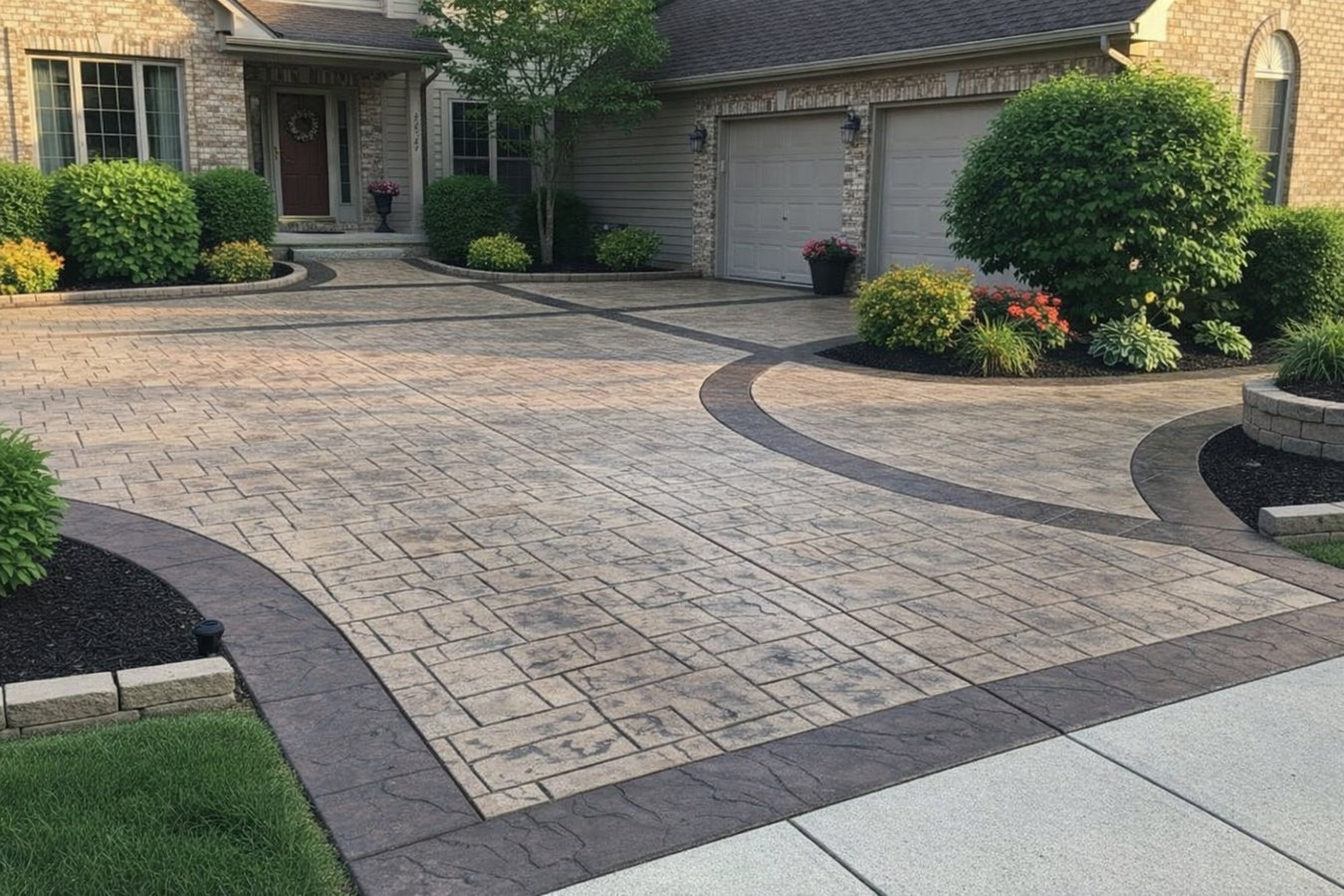
Newton's older homes often have original brick or bluestone patios that have shifted and separated as the subbase underneath settled over decades. Replacing them with a reinforced concrete slab gives a stable, level surface that handles freeze-thaw cycles without annual re-leveling. Decorative finishes — stamped concrete, exposed aggregate — match the aesthetic quality expected in Newton Centre and Chestnut Hill.
Newton's larger lot sizes typically allow for full two-car driveways with room to set proper subbase depth and drainage slopes. Many properties have original asphalt driveways that have failed at the edges or settled at the midpoint. Concrete poured to 4 to 5 inches on a well-compacted granular base holds up significantly longer in this climate and reads as a quality upgrade in Newton's competitive housing market.
Victorian and Colonial homes in Newton often have ornamental front entries where brick or stone steps have cracked and shifted over time. Cast-in-place concrete steps set on frost-depth footings stop the cycle of annual repairs and bring older entries up to current code for riser height and tread depth — an issue buyers and inspectors flag consistently on Newton's older homes.
Newton's hilly terrain — pronounced in Newton Highlands, Chestnut Hill, and near the Heartbreak Hill stretch of Commonwealth Avenue — produces substantial grade changes on residential lots. A concrete retaining wall designed with proper drainage behind it manages slope without the annual movement that walls without drainage detailing develop within a few winters.
Watertown borders Newton directly to the north along the Charles River. If you own property on both sides of the town line or need concrete work near the Newton-Watertown boundary, one crew handles the full scope with separate permits pulled per municipality — no need to manage two contractors for work that straddles the town line.
Newton's combination of large lot sizes, high household incomes, and a housing stock that skews toward substantial single-family homes creates steady demand for pool deck work. In-ground pools are common across the city's larger-lot villages — Waban, Newton Highlands, West Newton, and Auburndale among them — and many of the surrounding decks were poured decades ago without the air-entrained mix designs or proper control joint spacing that give concrete the durability to survive New England winters without surface scaling.
Newton's climate is hard enough on concrete that the gap between an adequate pool deck and a durable one shows up quickly. The city experiences roughly 80 or more freeze-thaw cycles per heating season. A pool deck poured without air entrainment, or sealed improperly, will begin spalling within a few winters as moisture works into the slab and expands during freezing. The repair cycle — patch, crack, patch again — eventually leads property owners back to full replacement. Doing it correctly the first time, with the right mix and sealer, costs less over a 15- to 20-year horizon than repeated patching on a surround built for a milder climate.
Newton's active real estate market adds a separate pressure. At home values consistently near or above $1.5 million, buyers expect outdoor surfaces that look finished, not patched. A pool deck showing visible cracking or surface pitting during a showing becomes a negotiating point. Stamped concrete and exposed aggregate finishes hold up to the scrutiny Newton's market applies and do it without the ongoing re-grouting and re-leveling that pavers or natural stone require after a few hard winters.
Newton pool deck projects frequently require a pump truck because the pool surround sits in a rear yard accessible only through a narrow side passage — a site condition we see consistently on the larger but still constrained lots in villages like Newton Highlands and Newtonville. We assess equipment access during the site visit and build the pump truck cost into the estimate before you sign anything, not on pour day when it is too late to compare options. Building permit applications for pool deck construction in Newton go through the Newton Inspectional Services Department, and we are familiar with the checklist and inspection schedule for residential pool deck permits at that office.
Commonwealth Avenue and Washington Street are Newton's primary east-west arterials, and the Green Line D branch runs parallel to the Pike from Newton Centre through Newtonville toward Riverside. Properties near the Charles River waterfront in Auburndale and Newton Lower Falls — close to the Hemlock Gorge Reservation — can encounter soft soils and elevated groundwater that require extra subbase management before any concrete is placed. We document these conditions during the site visit and reflect them in the estimate rather than discovering them after excavation begins.
We work frequently in neighboring Brookline, which shares Newton's eastern boundary and a similar high-value housing stock, and in Cambridge, where our base of operations is located. Newton properties near either border are handled by the same crew with permits pulled separately per municipality.
Reach us by phone or the estimate form. We reply within 1 business day. For pool deck work, knowing the approximate square footage of the surround, the current surface condition, and whether the pool area has rear access for a ready-mix truck helps us prepare for the site visit.
We walk the site, confirm equipment access, measure the surround, and assess subbase and drainage conditions. The written estimate itemizes demolition, subbase, concrete, finishing, and cleanup separately. Cost is addressed line by line at this stage — no bundled figures that obscure what you are paying for.
We file the building permit with Newton's Inspectional Services Department before any work begins. Once the permit is in hand — typically 2 to 4 weeks for a residential pool deck — we schedule the pour with the air-entrained mix and any access equipment already confirmed in the estimate.
Foot traffic is safe after 24 to 48 hours. Heavy furniture and pool equipment return after 7 days. Sealer application waits for the 28-day curing period. We walk through the finished surface and cover first-winter care: which deicers to avoid and when to schedule the first reseal.
We respond to every Newton inquiry within 1 business day. There is no obligation on the estimate. After your first contact, we schedule an on-site visit, confirm which Newton permits apply, and provide a written cost breakdown — pool deck, driveway, steps, or patio — before any work begins.
(617) 613-7966Durable concrete driveways designed for heavy use, proper drainage, and long-term curb appeal.
View serviceCustom concrete patios built to complement your outdoor space and withstand New England weather.
View serviceStamped concrete that replicates stone, brick, or tile textures at a fraction of the material cost.
View serviceCode-compliant sidewalks and walkways poured to smooth, safe finishes for residential and commercial properties.
View serviceReinforced garage floor slabs finished for vehicle traffic, moisture resistance, and easy cleaning.
View serviceStained, polished, and textured finishes that turn plain concrete surfaces into attractive design features.
View serviceStructural retaining walls that manage soil erosion, grade changes, and drainage on your property.
View serviceInterior and exterior concrete floors poured level, sealed, and finished to your spec.
View serviceSlip-resistant pool deck surfaces that stay cool underfoot and hold up to poolside moisture.
View serviceSolid concrete steps and stoops built to exact rise-and-run dimensions for safety and aesthetics.
View serviceMonolithic and post-tension slab foundations engineered for residential and light commercial structures.
View serviceFull foundation installation including excavation prep, forming, pouring, and waterproofing.
View serviceCommercial-grade parking lots with proper base prep, reinforcement, and striping-ready finishes.
View serviceAccurately poured footings for decks, additions, fences, and structural columns.
View serviceFoundation lifting and leveling to correct settlement, improve clearance, or meet flood-zone requirements.
View servicePrecision concrete cutting for utility access, expansion joints, and renovation demolition work.
View serviceServing these cities and communities.
Call now or send a message for a written, no-obligation estimate on pool decks, patios, driveways, or steps anywhere across Newton's 13 villages.