Cambridge Concrete installs slab foundations, concrete driveways, sidewalks, steps, and retaining walls throughout Quincy, MA. Quincy is one of Massachusetts' largest cities — 101,636 residents at the 2020 Census — spread across diverse neighborhoods from Wollaston Beach to Marina Bay and Quincy Center. The city's mix of dense multi-family housing, older single-family stock near the historic downtown, and newer waterfront condominiums each present distinct concrete challenges. Cambridge Concrete has completed concrete projects across Greater Boston since 2022, pulling permits through Quincy's Inspectional Services Department on every structural project.

Quincy sits about 8 miles south of downtown Boston along Quincy Bay and the Neponset River, making it the largest city in Norfolk County and one of the most transit-connected suburbs in the region. Four MBTA Red Line stops — North Quincy, Wollaston, Quincy Center, and Quincy Adams — connect residents to Boston in 25 to 30 minutes, and Old Colony commuter rail service runs from Quincy Center. That transit infrastructure has driven higher-than-average residential density, with a substantial share of the city's housing stock consisting of multi-family buildings, condominiums, and two- and three-family homes built between the 1910s and 1960s.
The city carries the nickname "City of Presidents" as the birthplace of Presidents John Adams and John Quincy Adams, and the surrounding built environment reflects centuries of development — from the older residential blocks near the historic downtown to the newer waterfront district at Marina Bay. The Wollaston Beach stretch along Quincy Shore Drive is the largest public beach in Boston Harbor, and Merrymount Park near Quincy Bay anchors the residential neighborhood of the same name. Quincy also earned the nickname the "Granite City" for its 19th-century quarrying industry, which left a physical imprint on the region's older building stock.
We work regularly in neighboring Brookline, which sits north of Quincy along the Route 9 corridor, and in Cambridge, where our base of operations is located. Projects near any of these town lines are handled by the same crew with permits pulled per municipality.
Quincy's soil conditions vary widely by neighborhood. Areas near the waterfront and Quincy Bay include fill and softer coastal soils that require geotechnical assessment before slab thickness and reinforcement can be finalized. Massachusetts's 48-inch frost line also means simple slab-on-grade designs need thickened, insulated perimeter edges for exterior-bearing applications. We assess subgrade conditions on site and design to the actual ground conditions — not a generic assumption.
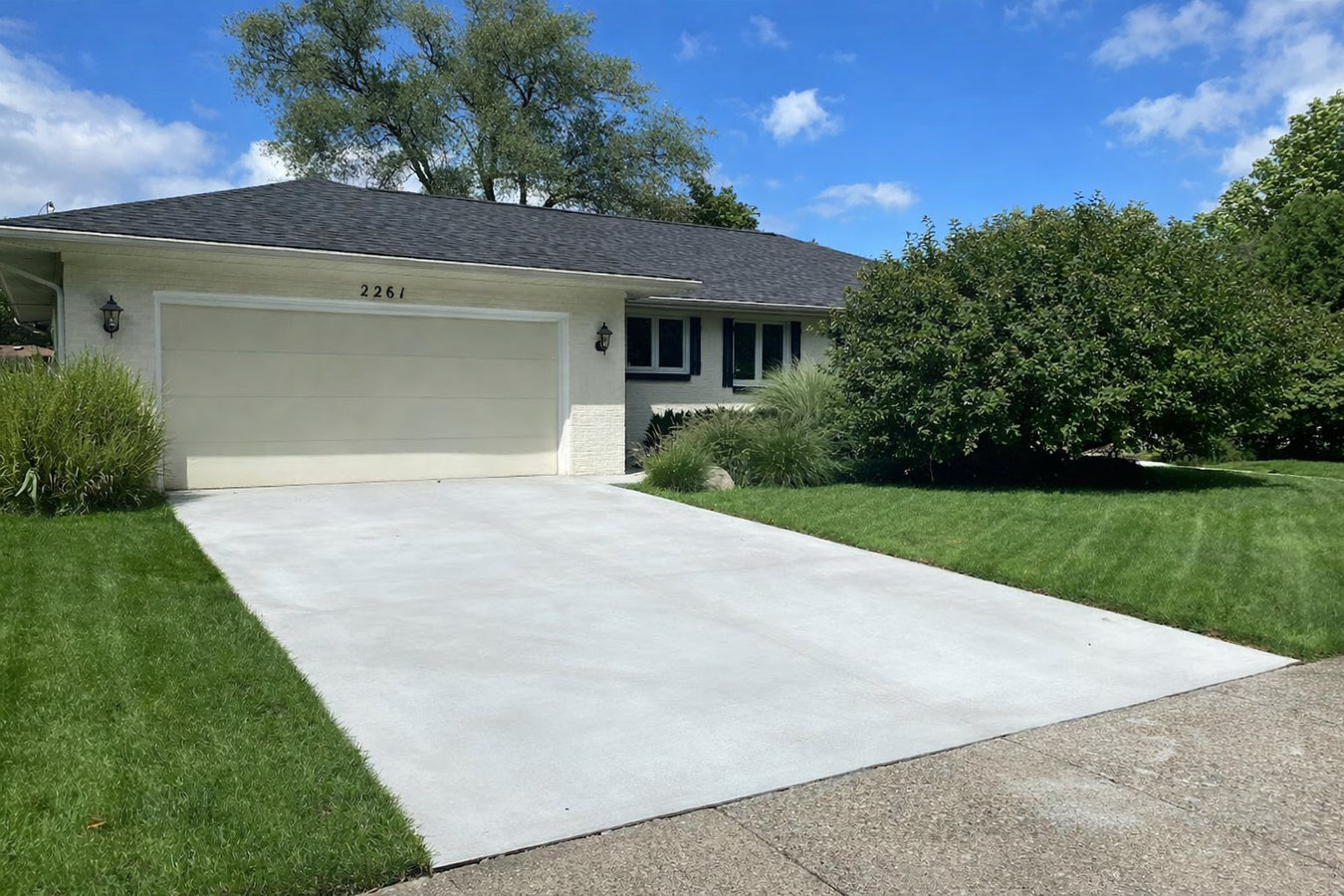
Quincy's dense residential streets — particularly in the Wollaston and North Quincy neighborhoods — typically have short driveways alongside two- and three-family homes. Road salt applied heavily throughout winter to Quincy's busy arterials tracks directly onto these driveways and accelerates surface scaling on concrete that was not air-entrained when originally placed. We pour to minimum 4-inch depth with air entrainment specified for Massachusetts's severe weathering classification.
Quincy property owners bear maintenance responsibility for the sidewalk panels abutting their lot. Panels that have displaced vertically — typically from tree root growth or frost action on inadequate subbase — create trip hazards that the city can compel owners to repair. We pull the right-of-way permit, replace panels in air-entrained concrete, and set cross-slopes within ADA limits so the work passes city inspection.
Quincy's older multi-family buildings near downtown and along the Wollaston neighborhood corridors typically have front entries with steps that have cracked or separated from the foundation. The lasting repair is excavation to frost depth, a new reinforced footing, and cast-in-place steps with consistent rise and run. Steps built this way remain anchored through frost cycles rather than pulling away from the building each winter.
New construction and addition projects in Quincy's residential neighborhoods require foundations that account for the city's frost depth, soil variability, and in some areas proximity to the water table. We coordinate with Quincy's Inspectional Services permit process and, where groundwater is present, develop a dewatering approach before excavation begins rather than managing it as a surprise during the pour.
Brookline borders Quincy's service corridor to the north along the Route 9 and Route 1 corridors. If you own property in both communities or need concrete work in areas between the two, one crew covers the full scope with separate permits pulled per municipality — no need to coordinate multiple contractors across town lines.
Quincy's position as one of Greater Boston's most accessible southern suburbs — with four Red Line stops and direct commuter rail service — has sustained strong residential demand for decades. That demand, combined with a housing stock where a substantial share of buildings predate 1960, means concrete flatwork and foundation work show up consistently across the city. Older slabs that were poured thin, without reinforcement or vapor retarders, have reached the end of their practical life in many properties from Quincy Center to the Merrymount neighborhood.
The geography adds specific pressure. Quincy's proximity to Quincy Bay, the Neponset River, and Boston Harbor means portions of the city — particularly near Wollaston Beach, the Marina Bay waterfront, and lower-lying areas along the harbor — sit on soil profiles that include fill and softer coastal material. Concrete work in these areas requires more than a standard subbase approach. A slab poured onto unassessed fill near the waterfront can settle unevenly within a few years as the subgrade consolidates, producing cracked floors and sloped surfaces that are expensive to correct after the fact.
Massachusetts's 48-inch frost line applies in Quincy exactly as it does across the rest of the state. Any exterior-bearing concrete — perimeter footings, garage slabs with thickened edges, entry steps — must extend to or account for that frost depth, or frost heave will displace it over time. The volume of older construction in Quincy means that frost-damaged concrete steps, cracked driveway aprons, and displaced sidewalk panels are among the most common projects we see from homeowners in this city.
Foundation and slab projects in Quincy near the Wollaston Beach corridor and the Marina Bay waterfront district require a dewatering plan before excavation begins — the Quincy Inspectional Services Department building permit checklist specifically calls for this when groundwater is likely to be present, and we have seen it encountered at relatively shallow depths on low-elevation lots in those neighborhoods. That is not a complication we surface after excavation starts; it is something we assess during the site visit and address in the estimate and permit package before work begins.
Quincy Shore Drive runs the full length of Wollaston Beach along the harbor. Hancock Street connects the historic downtown and the Adams National Historical Park visitor center at its core. Southern Artery and Falls Boulevard are the primary commercial corridors connecting the city's residential neighborhoods to the south. Multi-family blocks north of Quincy Center, particularly along the Red Line corridor toward North Quincy, have dense lot coverage that can make equipment staging tight and occasionally requires pump truck delivery for rear-yard concrete work.
We work frequently in neighboring areas to the north and in Waltham, where foundation and slab work in similar older suburban housing stock follows comparable permit processes. Each municipality is permitted separately; we manage that paperwork so you do not have to.
Reach us by phone or the estimate form. We reply within 1 business day. For foundation work, noting the neighborhood, whether the project is new construction or replacement, and any known history of water in the area helps us prepare the right questions before the site visit.
We walk the site, assess subgrade conditions and drainage, confirm equipment access, and check for signs of groundwater. The written estimate covers excavation, subbase, vapor retarder, reinforcement, concrete, and forming separately — with cost addressed line by line so there are no vague figures left to interpret.
We file the building permit with Quincy's Inspectional Services Department and submit the Dig Safe notification at least 72 hours before any excavation — both required by law before ground is broken. No structural work begins until the permit is in hand. The air-entrained concrete mix for this climate is specified in the permit package.
After the pour, concrete reaches walking strength in 24 to 48 hours and structural load capacity in 7 days. Full design strength takes 28 days. We schedule the required Quincy inspection, walk through the finished work with you, and provide care guidance for the first winter — what to use and what to avoid on fresh concrete.
We respond to every Quincy inquiry within 1 business day. The estimate carries no obligation. After your first contact, we schedule an on-site visit, confirm which Quincy permits and Dig Safe notifications apply, and provide a written breakdown covering all line items before any work begins.
(617) 613-7966Durable concrete driveways designed for heavy use, proper drainage, and long-term curb appeal.
View serviceCustom concrete patios built to complement your outdoor space and withstand New England weather.
View serviceStamped concrete that replicates stone, brick, or tile textures at a fraction of the material cost.
View serviceCode-compliant sidewalks and walkways poured to smooth, safe finishes for residential and commercial properties.
View serviceReinforced garage floor slabs finished for vehicle traffic, moisture resistance, and easy cleaning.
View serviceStained, polished, and textured finishes that turn plain concrete surfaces into attractive design features.
View serviceStructural retaining walls that manage soil erosion, grade changes, and drainage on your property.
View serviceInterior and exterior concrete floors poured level, sealed, and finished to your spec.
View serviceSlip-resistant pool deck surfaces that stay cool underfoot and hold up to poolside moisture.
View serviceSolid concrete steps and stoops built to exact rise-and-run dimensions for safety and aesthetics.
View serviceMonolithic and post-tension slab foundations engineered for residential and light commercial structures.
View serviceFull foundation installation including excavation prep, forming, pouring, and waterproofing.
View serviceCommercial-grade parking lots with proper base prep, reinforcement, and striping-ready finishes.
View serviceAccurately poured footings for decks, additions, fences, and structural columns.
View serviceFoundation lifting and leveling to correct settlement, improve clearance, or meet flood-zone requirements.
View servicePrecision concrete cutting for utility access, expansion joints, and renovation demolition work.
View serviceServing these cities and communities.
Call now or send a message for a written, no-obligation estimate on foundations, driveways, sidewalks, or steps anywhere in Quincy, MA.